Your dog is more than just a pet; they are a cherished member of the family. There is nothing better than snuggle time on the sofa or having your furry companion sleep beside you on the bed. However, for small breeds, seniors, or dogs with joint issues like arthritis, those jumps can be dangerous or even impossible. This is where a safe, custom-built dog ramp becomes essential for their long-term health and happiness.
Jumping down from heights repeatedly puts severe stress on a dog’s hips, elbows, and spine. Preventing this impact is the single best way to protect their mobility as they age. This complete guide will walk you through the process of how to build a DIY dog ramp for sofa or bed access. We will cover everything from safety specifications and material lists to simple, step-by-step construction instructions. Let’s start building a safer, happier life for your best friend today.
Why Your Dog Needs a Bed or Sofa Ramp
Many pet owners don’t realize the cumulative damage caused by everyday jumping until it’s too late. Repeated leaps strain ligaments and exacerbate conditions like Hip Dysplasia and Luxating Patella. Using a gentle dog bed ramp preserves joint cartilage and minimizes unnecessary wear and tear.
It is a crucial proactive measure, not just a reactive fix for mobility problems. A ramp increases your dog’s confidence and independence, allowing them to enjoy their favorite spots without assistance. This is especially vital for breeds prone to back problems, such as Dachshunds, Corgis, and Basset Hounds.
The investment of time in building a safe ramp pays off in years of comfort for your dog.For extra protection, consider using a Dog Couch Covert to keep your sofa safe from scratches and accidents while your dog uses their new ramp.
Injury Prevention for Small and Senior Dogs
Small dogs, despite their size, often incur injuries trying to clear the height of a couch or standard bed. The sheer force on their tiny bodies when landing is disproportionate to their size. Senior dogs face the opposite challenge, often lacking the strength or flexibility for a simple jump.
Even a slight misstep can lead to a costly vet visit and long recovery time. A custom DIY dog ramp for sofa height eliminates this risk entirely. It provides a simple, continuous slope that allows them to climb safely, maintaining their dignity and avoiding pain.
Safety First: Vet-Approved Ramp Design Tips
When you decide to build a ramp, safety must be the absolute priority over aesthetics. A poorly designed or unstable ramp is just as dangerous as jumping itself. The ramp needs to be rock-solid, gentle on the joints, and provide excellent traction.
Always use non-toxic, pet-safe materials for your ramp’s construction and finishing. Consider the maximum weight and stride length of your specific dog when drawing up your initial pet ramp plans. A wider, sturdier ramp is always preferable to a narrow, wobbly design.
The Ideal Slope Angle for Your Dog Ramp
The angle of the ramp is the most critical element for joint safety. The shallower the slope, the easier it is on your dog’s joints. For senior dogs or those with severe mobility issues, a slope between 18 and 20 degrees is ideal.
For healthy, younger dogs or small breeds, you can go slightly steeper, but try not to exceed 25 degrees. To achieve a shallower slope, you simply need a longer ramp for a given height. Always prioritize length to keep the angle as low as possible.
Measuring for the Perfect Fit
Accurate measurements are the foundation of any successful DIY dog ramp for sofa project. You will need three key measurements: the height, the length, and the width.
First, measure the exact height from the floor to the top of your sofa or bed cushion. This is the ‘rise’ of your ramp. Second, based on your ideal slope (e.g., 20 degrees), calculate the required ‘run’ or length of the ramp. A common rule of thumb is a 4:1 ratio (4 feet of length for every 1 foot of height) for a gentle slope. Finally, determine the width. We recommend a minimum width of 12 to 16 inches, depending on the size of your dog, to ensure stability and confidence when walking.
Gathering Materials and Essential Tools
Building a safe, durable dog bed ramp requires only basic woodworking materials, mostly found at your local hardware store. We will focus on a sturdy plywood and lumber design for maximum stability and ease of construction.
Lumber and Structural Materials
1. Plywood (3/4″ thickness): Needed for the ramp surface (the part your dog walks on).
2. Lumber (2x4s or 1x4s): Used for the structural frame (sides, top, and bottom supports). Choose straight, knot-free pieces.
3. Carpet or Rubber Tread Material: Essential for traction. Low-pile, indoor/outdoor carpet or rubber matting works best. Avoid slippery materials.
4. Heavy-Duty Wood Screws (1.5” and 2.5”): For assembling the frame and attaching the surface.
Essential Tools for the Job
1. Power Drill/Driver: For pilot holes and driving screws.
2. Circular Saw or Hand Saw: To cut the lumber and plywood to the correct lengths and angles.
3. Measuring Tape and Pencil: Precision is key for stable joints.
4. Safety Gear: Gloves and safety glasses are a must for any DIY project.
5. Sandpaper or Electric Sander: For smoothing sharp edges that could injure your dog or damage furniture.
6. Staple Gun: Heavy-duty for securing the carpet to the ramp surface.
Step-by-Step: Build Your Custom Dog Ramp
Follow these steps carefully to build a ramp for dogs that is safe, sturdy, and built to last. Remember to “measure twice, cut once” to save time and materials.
Step 1: Cut the Wood Components
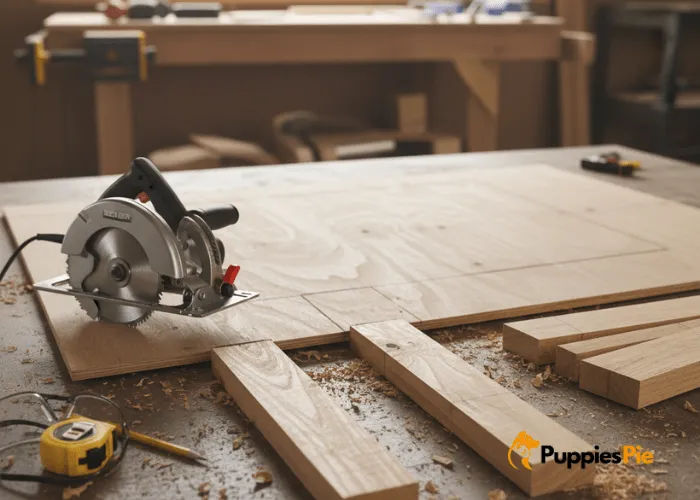
Based on your measurements, begin by cutting the major pieces. You will need two long side panels, which form the profile of the ramp. Use your 2x4s or 1x4s for these. Cut one end of each side panel at an angle (the angle of your desired slope) so it sits flush on the floor.
The other end should be cut perpendicular to the ramp edge, allowing it to rest neatly against the bed or sofa. Next, cut the plywood sheet to the exact width and length of your side panels. This will be the flat walking surface. Finally, cut several shorter pieces of lumber (2x4s or 1x4s) for the internal support cross-braces.
Step 2: Assemble the Ramp Frame
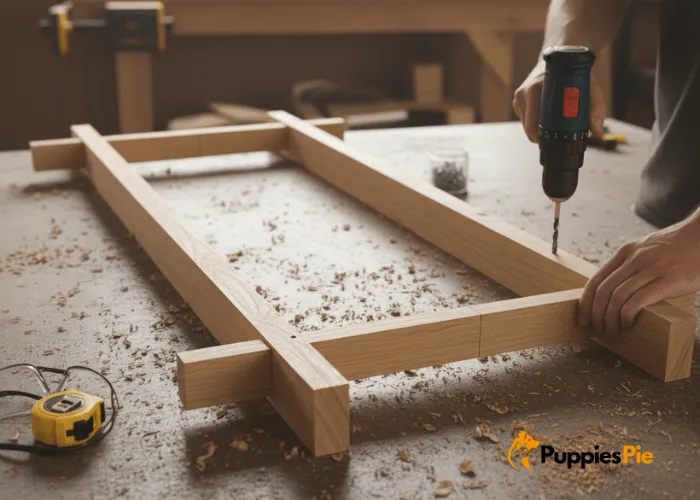
Lay the two side panels parallel on the floor, spaced apart by the desired ramp width. Position the shorter cross-braces between the side panels. One brace should be placed right at the top, one at the bottom, and the remaining ones spaced every 12 to 18 inches down the length. These braces provide essential structural support and prevent the ramp from bowing.
Using your power drill, pre-drill pilot holes to prevent the wood from splitting. Then, secure the cross-braces to the side panels using the 2.5” wood screws. This frame is the skeletal structure that must be incredibly stable. Double-check all connections to ensure there is absolutely no wobble.
Step 3: Attach the Ramp Surface
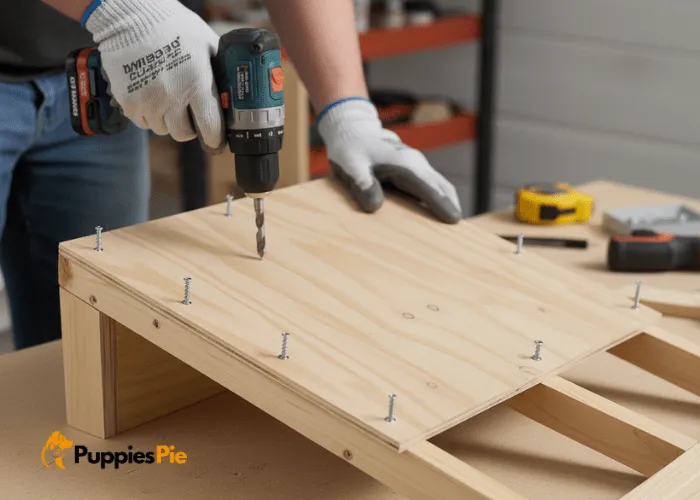
Take your pre-cut plywood surface and lay it directly over the top of the newly assembled frame. Align all the edges precisely. This plywood must be strong enough to support your dog’s weight without any flex.
Starting from the top and working your way down, drive the 1.5” wood screws through the plywood and into the side panels and all internal cross-braces. Place a screw every 6 to 8 inches along the entire perimeter and over every support brace. Ensure all screw heads are slightly countersunk below the surface of the wood. This prevents any snagging when the carpet or traction material is applied.
Step 4: Add the Traction (Carpet/Treads)
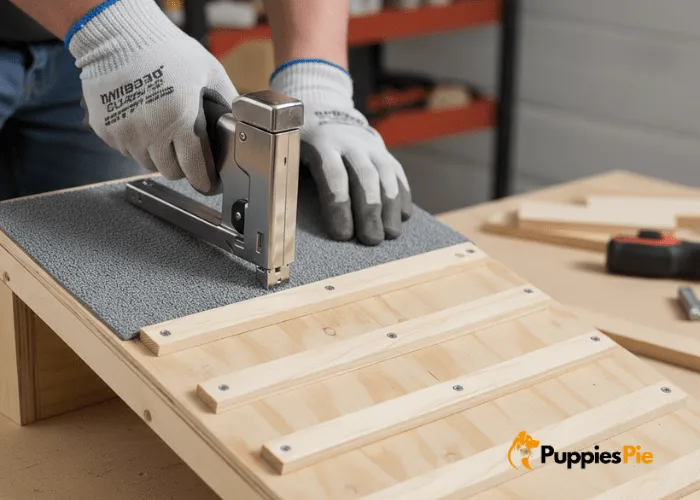
This step is arguably the most important for pet ramp safety. A smooth wood surface is too slick, which can cause dogs to lose footing and become fearful of the ramp. You must provide ample traction.
Cut your chosen carpet or rubber mat material to overlap the plywood surface slightly. Starting from the top, use a heavy-duty staple gun to secure the material tightly to the plywood and around the edges. Space the staples about 1 inch apart along the perimeter for a secure, wrinkle-free finish. Alternatively, you can use thin wooden slats, called treads, secured horizontally every 6-8 inches across the ramp. These treads provide excellent grip, acting like mini-steps on the slope.
Step 5: Finishing and Safety Check
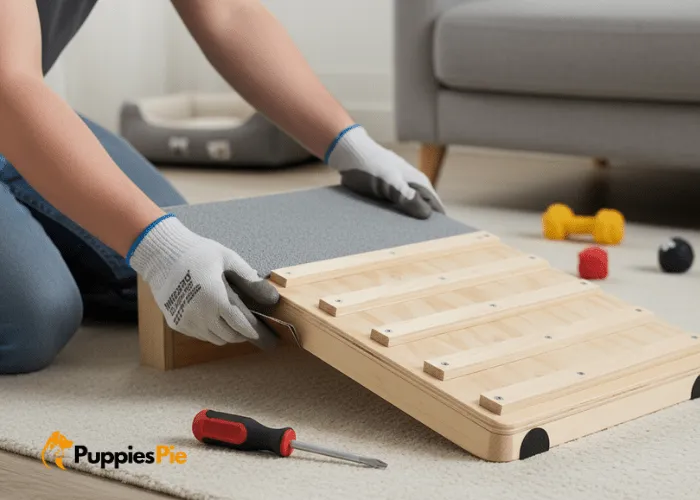
Before introducing your dog to their new access point, a thorough safety inspection is mandatory. Use sandpaper to smooth all edges, paying close attention to the exposed corners and the top edge that rests against the furniture. Splinters are a hazard for both you and your dog.
Check that all screws are firmly in place and that the carpet is securely fastened. Place the ramp in its intended position against the sofa or bed. If the ramp shifts or slides on a slick floor, consider adding rubber non-slip pads or grips to the bottom of the ramp’s feet. A ramp that slides is a ramp your dog will be afraid to use.
Customizing Your DIY Dog Ramp
Once the basic structure is complete, you can customize your ramp to fit your home’s décor and your specific needs. This is where your DIY dog ramp for sofa goes from functional to fantastic.
Aesthetics and Style
1. Paint or Stain: If you haven’t applied carpet, a clear polyurethane sealant protects the wood and makes cleanup easy. You can also paint the side panels to match your wall or furniture color. Always use non-toxic, pet-safe paints and allow them to fully cure before use.
Pairing the ramp with a cozy Dog Bed (No-Sew Pillow Bed) at the top ensures your dog can relax comfortably after climbing, making it a perfect landing spot.
2. Side Rails: For extra timid or small dogs, adding low side rails (using thin strips of lumber) can increase their confidence. This gives them a visual boundary, making them less likely to wander off the edge.
3. emovable Covers: If you chose a carpeted surface, consider making the cover removable. This allows you to easily wash or replace it when it becomes worn or soiled.
Functionality and Storage
1. Foldable Design: If you need to store the ramp frequently, incorporate a hinge mechanism. By cutting the ramp in two sections and connecting them with a sturdy, heavy-duty hinge, you can create a foldable dog bed ramp that stores flat under a bed or in a closet.
2. Storage Box Integration: If you are using 2×4 lumber for the side panels, you can build a deeper, hollow frame. By adding a hinged door to the side panel, the ramp doubles as hidden storage for toys, leashes, or grooming supplies. This is a great space-saving feature.
If you’re looking to revamp your dog’s space entirely, a Dog Crate Makeover can complement your ramp setup, giving them a secure and organized area for rest and play.
Training Your Dog to Love the Ramp
Even the best-built ramp is useless if your dog is afraid to use it. Many dogs are cautious around new objects, so training must be done patiently and positively. Never force or drag your dog onto the ramp.
Start with the ramp positioned flat on the floor, disconnected from the furniture, so it’s less intimidating. The goal is to make the ramp a source of positive reinforcement and reward. Keep all training sessions short (5 minutes or less) and fun.
Simple Ramp Training Steps
1. Introduce and Explore: Let your dog sniff the ramp at their own pace. Place a favorite toy or a high-value treat near the ramp, not on it, for a few days to build familiarity.
2. Lure to the Surface: Place a treat halfway up the ramp. Gently lead your dog onto the lower section with a leash or a clear hand signal. As soon as they take one step, reward them lavishly.
3. Ascend and Descend: Once comfortable with the middle, place the treat at the top. Use an excited, encouraging voice as they walk up. Once they reach the top, jackpot them with praise and treats. Immediately practice descending, which is often scarier for dogs, rewarding them for a calm walk down.
4. Connect to Furniture: Only when your dog is confidently using the ramp on the floor should you position it against the sofa or bed. Repeat the training at this final location.
Troubleshooting Common Ramp Hesitation
If your dog refuses to use the ramp, the issue is usually related to sound, steepness, or texture. Check if the ramp creaks or shifts—this is terrifying for a dog. If it is wobbly, reinforce the frame and add non-slip feet.
If the angle is too steep, it may be causing discomfort. The only fix for this is building a longer, shallower ramp. Finally, if the carpet texture is uncomfortable, try a different material like rubber treads. Sometimes, simply placing a favorite blanket or bed at the top of the ramp can provide the necessary motivation.
The Confidence and Health Benefits
By taking the time to build a ramp for dogs, you are giving your pet a tremendous gift: autonomy. They no longer have to wait for you to lift them up or worry about the pain of jumping down. Their confidence will visibly increase as they move freely around the home.
More importantly, you are protecting their physical health by eliminating years of cumulative joint damage. This simple structure ensures your beloved companion can stay active and comfortable, enjoying their favorite spots for many years to come. This is truly an act of love.
Conclusion
Building a DIY dog ramp for sofa or bed access is a rewarding project that pays dividends in your dog’s long-term health and independence. You have learned how crucial a shallow slope and non-slip surface are for safety and joint preservation.
By following our step-by-step guide, you now have the tools to construct a sturdy, custom ramp perfectly suited to your home and your dog’s needs. We encourage you to start this simple, yet life-changing, build this weekend. Share your finished dog bed ramp projects with us in the comments!